


Journaling Prompts for Anxiety: 50 Powerful Ways to Find Calm
This post may contain editorial samples and/or affiliate links. We earn a commission on your sales.

When your mind won’t slow down, even small worries can start to feel much bigger than they really are. Journaling prompts for anxiety can give all of those thoughts somewhere to go instead of letting them keep circling around in your head.
I know that feeling well.
I live with anxiety and depression, and I’m always looking for realistic ways to help myself manage both. Journaling is one of the things I keep coming back to because sometimes I simply need to get everything out of my head and onto paper.
That doesn’t mean journaling is always easy.
Sometimes it gets emotional. I’ve written things down and realized I was carrying more than I thought I was. Other times, seeing my thoughts on paper has helped me realize that something taking up a huge amount of space in my mind wasn’t quite as overwhelming once I could actually look at it.
That’s part of what makes journaling so therapeutic for me.
You don’t have to write pages and pages, either. Sometimes one question and a few honest sentences are enough.
If you’ve been looking for journaling prompts for anxiety that can help you slow down, sort through your thoughts, and understand what you need, I’ve put together 50 prompts to help you get started.
Table of Contents
Why Journaling Can Help When Your Mind Won’t Slow Down

Anxiety has a way of making thoughts multiply.
One worry turns into another. Then you’re thinking about what happened yesterday, what might happen tomorrow, what you should have said three weeks ago, and something that may never happen at all.
Before you know it, your brain feels full.
Journaling creates a place to put some of that mental noise.
Instead of trying to remember, solve, analyze, and prepare for everything at once, you can write down one thought and focus on that.
You may start noticing patterns, too.
Maybe certain situations tend to trigger your overthinking. Maybe you’re putting pressure on yourself that you wouldn’t put on someone else. Maybe you’re spending a lot of energy worrying about something completely outside your control.
You don’t necessarily notice those things when all the thoughts are competing for your attention.
Writing slows the process down.
And if you’re working on managing anxiety beyond journaling, I’ve also shared 5 Ways to Deal With Anxiety Long-Term with some of the strategies that can help you build support into everyday life.
You Don’t Have to Be “Good” at Journaling

One reason people sometimes hesitate to start journaling is because they think there is a right way to do it.
There isn’t.
Your journal doesn’t have to look pretty. Your handwriting doesn’t matter. You don’t need a special notebook, colorful pens, stickers, or an elaborate morning routine.
You also don’t have to write every day.
This is something I think is especially important when you’re using journaling prompts for anxiety. Journaling shouldn’t become another obligation you’re worried about keeping up with.
Use it when it helps.
Write one sentence.
Fill three pages.
Choose one of the journal prompts for overthinking and spend five minutes answering it.
Close the journal halfway through if you’ve had enough.
The point is to give yourself space to process what you’re thinking, not to create another habit you feel guilty about doing imperfectly.
50 Journaling Prompts for Anxiety and Overthinking

I’ve divided these journaling prompts for anxiety into five groups. You don’t need to start with number one and work your way through all 50.
Look through them and choose the question that feels most useful today.
What’s On My Mind?
These first journal prompts for overthinking and anxiety can help when your thoughts feel crowded and you’re having trouble figuring out what’s actually bothering you.
- What is on my mind right now?
- What am I worried about today?
- What thought keeps repeating in my mind?
- What am I afraid might happen?
- Is this worry based on facts or fear?
- What do I know to be true right now?
- What am I assuming without knowing for sure?
- What is within my control today?
- What is outside of my control?
- What can I let go of for today?
Checking In With Myself

Anxiety isn’t always just thoughts. Sometimes you notice it in your emotions, your energy, or even how much tension you’re carrying.
Use these journaling prompts for anxiety to slow down and notice what you might need.
- What does my mind need a break from?
- What would help me feel calmer right now?
- What is making today feel heavy?
- What emotion am I feeling most strongly?
- What might be underneath that emotion?
- What does my body need from me today?
- Where am I holding tension right now?
- What would make today feel a little easier?
- What can I simplify today?
- What can wait until another day?
Want All 50 Prompts Ready to Print?
If you’d rather have these prompts somewhere you can actually write and work through them, I created the 50 Journaling Prompts for Anxiety & Overthinking Printable Journal.
It goes beyond the prompt list and includes guided pages for sorting through worries, identifying what you can control, grounding yourself, practicing kinder self-talk, letting go of what’s weighing on you, taking small steps, and reflecting at the end of the day.
Get the 50 Journaling Prompts for Anxiety & Overthinking Printable
Print the pages you need and come back to them whenever your thoughts feel especially busy.
Being Kinder to Myself

Sometimes the way we talk to ourselves adds another layer to an already difficult day.
These journaling prompts for anxiety encourage you to notice that inner voice and offer yourself some of the understanding you’d probably give someone else without thinking twice.
- Am I expecting too much from myself?
- What pressure can I release?
- What would I tell a friend who felt this way?
- How can I show myself that same kindness?
- What am I being too hard on myself about?
- What have I handled before that once felt difficult?
- What is one thing I am doing well?
- What am I proud of myself for today?
- What small win can I acknowledge?
- What am I grateful for in this moment?
Finding a Different Perspective
Overthinking can make one possibility feel like the only possible outcome.
These journal prompts for overthinking can help you slow down and look at what you actually know rather than automatically following every “what if.”
- What feels safe and comforting to me?
- What helps me feel grounded?
- What can I see, hear, or feel around me?
- What is going right today?
- What deserves more of my attention than this worry?
- Will this matter a week from now?
- Will this matter a year from now?
- What is the most realistic outcome?
- Am I trying to predict something I cannot know?
- Am I replaying something I cannot change?
Moving Forward
Not every journaling session needs to end with a solution.
But sometimes it helps to identify one small thing you can do next. These final journaling prompts for anxiety focus on releasing some of the pressure and deciding where you want to put your energy.
- What can this experience teach me?
- What do I need to forgive myself for?
- What permission do I need to give myself?
- What boundary would protect my peace?
- What can I say no to right now?
- What do I want to make space for?
- What is one small step I can take today?
- What can I do in the next 10 minutes?
- What do I want to remind myself tomorrow?
- What do I need to hear right now?

How to Use Journal Prompts for Overthinking
When you’re already overthinking, staring at a blank journal page can be frustrating.
That’s why prompts can help.
Instead of asking yourself to somehow untangle everything happening in your head, choose one question.
You might even set a timer for five or ten minutes.
Write whatever comes up without worrying about grammar, spelling, whether it makes sense, or whether you’re answering the question “correctly.”
You can also stop when you need to.
Some journal prompts for overthinking may bring up more emotion than you expected. I’ve experienced that myself. Journaling can be therapeutic, but sometimes getting those thoughts onto paper means finally acknowledging feelings you’ve been pushing aside.
You don’t have to push yourself to keep writing just because you started.
Take a break. Get a drink. Do something comforting. Come back later if you want to.
The journal will still be there.
Try Separating What You Can Control From What You Can’t

This is one of my favorite ways to use journaling prompts for anxiety when my thoughts start going in too many directions.
Take a page and divide it into two sections:
I can control
and
I cannot control
Maybe you can control whether you send an email, set a boundary, ask for help, rest, or take one small step toward solving a problem.
You can’t control another person’s response, something that already happened, or every possible outcome.
Seeing that distinction on paper can help you decide where your energy actually belongs.
You don’t have to stop caring about the things you can’t control. You’re simply recognizing that worrying harder isn’t necessarily going to change them.
Use Journaling as Part of Your Evening Wind-Down

Nighttime seems to be when the brain suddenly remembers everything it wanted to worry about.
You’re tired. You’re ready to sleep.
And your mind decides this is the perfect time to replay conversations, plan tomorrow, and bring up something embarrassing you did years ago.
Keeping a journal nearby can help you get some of those thoughts out before trying to sleep.
Choose one of the journal prompts for overthinking and anxiety, write down what’s bothering you, and give yourself permission to come back to it tomorrow if you need to.
If nighttime anxiety is something you struggle with, you may also find my guide to 4 Ways to Sleep With Anxiety: Calm Your Mind helpful.
What If Journaling Makes Me More Emotional?

It can.
And I think that’s worth talking about because journaling isn’t always the peaceful picture we see online with a beautiful notebook and a cup of tea.
Sometimes writing is messy.
Sometimes you’re angry.
Sometimes you cry.
Sometimes you write something and think, “Wow, I didn’t realize that was bothering me this much.”
I’ve had those moments.
For me, that’s also part of why journaling can feel so therapeutic. I’m giving those thoughts somewhere to exist outside my own head.
But you don’t have to force yourself through an uncomfortable journaling session.
If a prompt feels like too much today, skip it.
Choose another.
Or close the journal entirely.
Journaling prompts for anxiety are tools, not assignments.
You get to decide what feels helpful.
Give Your Energy a Reset Too
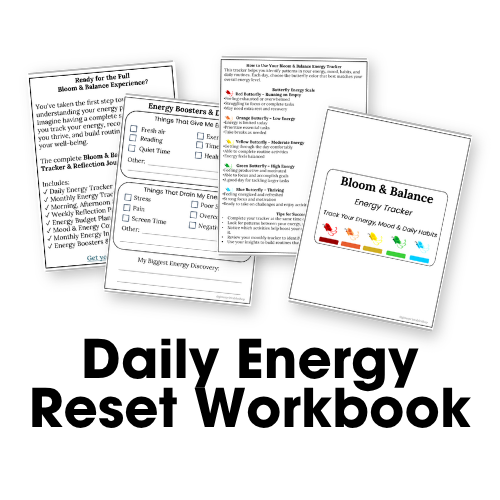
Sometimes it’s not just your thoughts that feel overloaded. Your energy can feel completely drained too.
That’s why I created my Daily Energy Reset Workbook, a free printable designed to help you pause, check in with yourself, and make more intentional choices about where your limited energy goes.
Get the Free Daily Energy Reset Workbook
Use it alongside your journal when you need a little extra help slowing things down and figuring out what you need today.
Find More Printables for Real Life
Looking for simple printables that help make everyday life feel a little less overwhelming? From planners and wellness tools to educational activities and family organization printables, you’ll find supportive resources designed for real life inside Gina’s Printable Shop.
I create practical printables for everyday life, including self-care, wellness, planning, home organization, family life, and more.
These aren’t about creating a perfect routine. They’re about giving you tools you can actually use when life feels busy, your energy is limited, or you simply want a little more structure.
Visit Gina’s Printable Shop to see what’s new and find the printable that fits what you need right now.
Start With One Prompt
You don’t have to work through all 50 journaling prompts for anxiety this week.
You don’t even have to work through all 50.
Start with one.
Maybe ask yourself, What is taking up the most space in my mind right now?
Write down whatever comes up.
Then see how you feel.
If you want to keep writing, choose another prompt. If you’ve had enough, close the journal and come back another day.
The goal isn’t to completely eliminate every anxious or overthinking thought. It’s to give yourself another way to slow down, understand what’s happening inside your head, and decide what deserves your attention.
That’s why I keep coming back to journaling myself. Getting those thoughts out of my head and onto paper doesn’t magically make everything disappear, but sometimes it makes what I’m carrying feel a little easier to understand.
And sometimes, that’s exactly what I need.
Follow Me On Social Media:

Hi, I’m Gina — the creator behind Chronically Gina and Gina’s Printable Shop.
I create practical printables, wellness tools, and encouraging content to help make everyday life feel more manageable. Living with chronic illness has inspired me to share realistic routines, organization tips, meal planning ideas, and supportive resources for busy women, families, caregivers, and teachers.
My goal is to help you feel less overwhelmed and more supported with simple systems that work for real life — not perfection.


